
Saturday, June 15, 2013
Gone Fishin'
Taking a bit of a break for the summer. I will continue to put up shorter pieces now and again on Medium. A list of my writing can be found at medium.com/@dorsalstream.
Stay cool, everyone. See you in the fall.


Wednesday, May 01, 2013
Do stop believing

A little before she turned 8, Q had a loose tooth succumb to a spoon full of lemon yogurt. As she wrote a note for the Tooth Fairy (asking for both the cash and the tooth to be left, please), Q announced that “There are no such things as fairies.” Instead, a “Tooth Person” exchanged cash for baby teeth. “So some person comes into our house. At night. For your teeth?” we asked. “Yes,” Q said, and finished the note with her name.
My lovely wife and I were both puzzled and a little disappointed by this in-between business. Puzzled because Q didn’t seem bothered by the removal of magic from the story, which in our opinion made it much creepier.* Disappointed because myth management is a lot of work, especially when you reside on the other side of the myth and have little personal investment in its truth. Myths are explanations by way of stories, and keeping the explanations satisfying (for yourself or others) means you have to anticipate the entailments and questions. We were prepared for the obvious: Our kids have grown up in apartments, and we knew they would wonder, after all the usual poems and TV specials, how Santa leaves them gifts in the night without a chimney.** Other questions (obvious now) caught us off guard, such as when they asked a few years ago, “What does the Tooth Fairy do with all those teeth?”***
I’m fine with telling Q and The Boy the truth of these things outright, instead offering them a competing explanation about deserved rewards and encouraged wonder and stuff like that. My lovely wife, to her credit and wisdom, has insisted that our kids come to these truths on their own. She believes that the various fairies and magic bunnies and nocturnal elves can give a great gift in the opportunity to discover their nonexistence.
This discovery is inevitable. Beliefs and the stories that bind them together tug at each other even as they distribute logical load. Beliefs that don’t square with the stories we tell ourselves tend not to last long. Same with stories that don’t square with beliefs we are reluctant to relinquish. Childhood myths survive until the evidence nags and the desire to know overpowers the desire to believe in their truth or what would allow them to be true. Once doubt arises, a little thinking can quickly erode the myth.
I figured the Tooth Fairy would be the first knocked loose by Q and The Boy since that fairy’s existence and purpose leads to more questions than answers pretty much right away. (What’s the money for anyway?) But the Easter Bunny became the first casualty. Its retirement proceeded as many belief revisions do, through a combination of salient empirical evidence and the compulsion to adjust the story to make sense of that evidence. The night before Easter Sunday, my wife and I were filling plastic eggs in our bedroom, as we have done every kid year, with jelly beans and comically small Milky Ways when Q came in saying her room was too hot. My wife quickly (and, therefore, suspiciously) sprang up and threw a blanket over the eggs on the bed, which caused them to bounce and rattle. I took Q quickly back to her room to turn on the fan while trying not to look or sound like I had a mouth full of candy.
____________________
*Some regular person sneaks in at night? How does he/she know when you’ve lost a tooth? Do we all have a mouth stalker? Also see note ***.
**The doorman knows him and lets him in, we said; he lands his sleigh on the roof deck and uses a magic key that opens all locks, electronic and otherwise, etc.
***I can’t remember our answer at the time. We might have just said that we didn’t know and then tried to deflect by asking why they (Q and The Boy) like to keep their teeth. In any event, I’m convinced no good answer to this question can be given.
Once convinced that Q was back asleep, we finished filling and hiding the eggs in our tiny living room, and we set out the larger sweets in their baskets. Later, my wife decided we had too many beans left in the bag, and she went back to fill the eggs further. One dropped in the dark.
Q spotted it right away in the morning. She put on that look of hers, the one where she narrows her eyes and smiles, the word ‘clever’ written in the cursive of her lips.
“The Easter Bunny forgot one,” she said. Paused. “What were you two doing last night with all those eggs?”
“What do you think we were doing?” her mother asked back. Lots of pausing. “Who do you think is the Easter Bunny?”
She didn’t answer. She wasn’t sure, caught again in that unsteady state between believing and not believing, between wanting to know and wanting to not know, as the story began to rewrite itself.
We spent the rest of the day pretending noticeably to each other that the Easter Bunny exists, mainly via a running joke about the Easter Bunny saving money with his Walgreens discount card.
I haven’t said much about The Boy during all of this, mainly because he himself didn't say much, even when asked. He is far more comfortable with not knowing than his sister. Q has a particularly strong desire to know, and she can’t help but think rigorously.
I find myself wondering whether I might have gotten it wrong, whether my picture of Q and The Boy, of us, of myself, mistakes how we are. Our story has the shape of myth, and I’ve grown comfortable with using it to explain just about everything.
Later that night, when Q and I were alone as her bath ran, she asked, “Are you really the Easter Bunny?”
“Do you really want to know?”
“Yes.” I could see that she did.
“Yep, we are.” She nodded. “Are you disappointed?”
“No.” A pause. “Not really.”
“Well, at least you know no giant magic rabbit comes into our house at night.”
Q said no more about it. She stepped into the bath and unfolded herself under the water, her toes tapping the overflow plate, her head now almost against the opposite end. She looked big, and bigger.
After their baths, Q and The Boy joined us on our bed, eating jelly beans straight from the Easter Bunny’s bag.
I don’t miss what they have given up. I prefer to work on this story.
____________________
*Some regular person sneaks in at night? How does he/she know when you’ve lost a tooth? Do we all have a mouth stalker? Also see note ***.
**The doorman knows him and lets him in, we said; he lands his sleigh on the roof deck and uses a magic key that opens all locks, electronic and otherwise, etc.
***I can’t remember our answer at the time. We might have just said that we didn’t know and then tried to deflect by asking why they (Q and The Boy) like to keep their teeth. In any event, I’m convinced no good answer to this question can be given.
Friday, February 22, 2013
Snow Rules

Q and The Boy have been like elite athletes — trained, equipped, ready. They’ve thought and re-thought their strategies, drafted elaborate fort plans, contemplated the proper packing of the snowball. They’ve revisited, over and again, the Calvin & Hobbes snowman strips for macabre inspiration. For Christmas this year, a California aunt gave The Boy two WHAM-O! Snowball Blaster Solos™ and one WHAM-O® Snow Tracball™, each package picturing an ecstatic boy firing a perfectly round snowball at someone unfortunate and unseen. But for the last two years, snow in New York has never gotten past the possible, and Q and The Boy have remained on the bench.
This year “Winter Storm Nemo”* brings them both into the game. Though the projections shift nearly every time we consult them (anywhere between 6”-22” expected, the graphic tells us), we watch the possibility of snow become a promise, and not the thin inch about two weeks prior that came down like fine sand and, in the bitter cold, stayed that way despite all our pressing and packing.
*It seems the Weather Channel figured out that they could name storms, too. Why not? Right?
**A friend of mine and I made an outstanding snow monster that was destroyed by someone less than an hour later.
Nemo makes the weekend a vacation. The storm comes in on Friday as rain and wind, and remains indecisive most of the day. Then with the sun down and the kids in bed (though probably not asleep), the clouds get serious about themselves, and the city becomes a celebration of snow.
Q and The Boy are up early that Saturday morning, turned out of bed by their expectations and ideas. We eat breakfast, something heavy (eggs and hash browns), and put extra layers between us and the world. Then, finally, outside.
About a foot has fallen in the night and together with the wind has re-landscaped the park. The benches have become easy chairs; the long slide is a trough full of white. Everything is new, but we are not the first. Though we get out fairly early, the park people have been out a little earlier, clearing the main walks with the red Toro tractor and its brush attachment throwing up a scarf of snow in a much smaller impression of the storm. Still it’s new enough.
All the park lawns have been fenced off for the season, as usual, to let the grass rest and come back in the spring. Normally our neighborhood fastidiously keeps to the rules. But in this new park, someone discovers a way into the smaller but steeper patch of ground through the leafless bushes on the side, and suddenly uncountably many kids are laughing down the grade on sleds, some official but most improvised—storage-container lids, cardboard boxes, boogie boards used to the temporary hills that come and go against the local shores. Q and The Boy find friends immediately (nearly everyone was out), which we eventually identify and track by their winter plumage: Suzie in purple, Scarlet ironically in all cerulean. Soon the hill gets sleighed smooth and fast, with the downhill fence checking the kids just short of the path where the parents stand holding cameras or coffees or both.
Then someone loosens a post and brings down a six-foot stretch of the big lawn’s fence roll, and in something like a moment it, too, fills with kids sliding on all manner of things, some pulled by adults to help out the smaller grade.
The Boy and his best friend T experiment with his snowball launcher, which turns out to shoot better in the picture, but its cup and lever attachment produce snowballs so round they would have made Plato blush. Q quickly gets good at making them herself and then wows her friends with their frequency and perfection. She ends up with a constant line of kids asking her to make ordinance to deploy mainly against their dads and brothers.
We spend as much of Saturday and Sunday outside making and destroying as we can,** knowing that time is against us. The parks people, to their credit, leave the fence down all weekend — never even appear to trigger guilt let alone end the play, come to think of it. It’s not until Sunday night, about the time when the neighborhood kids enter baths and beds and when lids have gone back onto containers and exhausted boxes have been put out for recycling, I stand at the window and watch workmen out resetting the posts and wiring back up the fence roll.
What is it about snow that overrules? It’s a serious question. I’ve heard a poet say that it’s a way to walk on water, but I find that no more an explanation than saying a kid’s love of sand comes from being able to fill buckets with glass. I do think there’s something to Bill Watterson’s idea, brilliantly realized again and again, that snow turns the world into a blank page that we are called to fill with the writings of our being.
Still, Watterson’s metaphor misses something important. It’s not just that snow erases the world’s full slate; it forgoes the slate altogether. Imagine if you could, just anytime, easily fashion the ground into a chair or a (relatively) harmless ball to test your arm on a sign or a sibling. Or if you could roll up a fort, tall as you like, and trigger a battle that will end (relatively) peacefully in a hot, marshmallowed drink inside. What if you could at any moment push the world into a new shape, and it would stay?
Then again, it never stays — can’t, at least for us. Metaphors tend to drift up. Sleds aside, the going’s harder in the snow, the cold always looking for your fingers and toes and always eventually finding them. But despite the struggle and the cold — and unlike in spring — in the snow you can reintroduce yourself as an explorer and can look back to proof of where you’ve been. And then, inevitably, you can’t tell your footsteps from all the others.
_________________________*It seems the Weather Channel figured out that they could name storms, too. Why not? Right?
**A friend of mine and I made an outstanding snow monster that was destroyed by someone less than an hour later.
Thursday, January 24, 2013
While Your Wife Is at a Memorial Service
She’ll be gone a good hour, perhaps two. You’re happy, of course, to watch the kids while she pays respects. Don’t think, obviously; nothing good can come of that. Try to make yourself useful instead. Maybe look for the long blue spatula, the one good for flipping hash browns for The Boy. It was a friend of hers, younger than you both. We’re getting to that age, I suppose, where such things shock but no longer surprise. Keeps them crispy to flip them all at once. The hash browns. Funny phrase “paying respects,” as if respect was a kind of currency, with death calling for an exchange. Also “paying attention,” though the expense of that seems to make more sense somehow. What language has us do. Also, the pencil sharpeners probably need emptying of their dust. Q will always be up for a game of Crazy 8s or Go Fish, played, if she has her way, with the novelty deck from the Boot Hill gift shop, the one with the neat hole in the middle pretending to be from a bullet. She can beat you now without your help, and the game will provide a good fence for your thoughts. The spatula should be in the drawer by the stove, like always. She had two children, both boys, one very young, not yet able to remember. You won’t be able to decide at which age it’s better to begin not having a mother. You will be sore tomorrow from those pushups for sure. Now is not a time to make promises to yourself. Better to see if anyone needs a snack. The Boy — these days you can almost see his cells busy doubling themselves — will undoubtedly want something. Not you, though; you have to protect yourself from your body. Drink more coffee instead. Now they say that it’s good for the brain and the liver, that you can never have too much, and you can have too much of so many things. Don’t imagine her never coming home, the house full of her things suddenly become the only bits of her you’re allowed to hold. Don’t think about how you would tell the kids about her but, without her to help you remember, how you would come to doubt whether she actually liked the opera or balsamic vinaigrette. Did the babysitter melt the handle on a hot pan lip and throw it out? The shorthand you share, the rich narrative that collects your lives into a tractable story, would soon require a translator, then likely lapse into an idiolect so unfamiliar that you would struggle to recognize it as a language at all. She’ll call soon, and you can all meet her out to eat. Maybe a new place; you should pick where. Not so much the worry of having to carry on alone with the kids, of losing her help with the vast effort of life, whether short-sleeves or long or pancakes again for breakfast, all that oppressive banality of choice, though that’s worrisome, too. It’s your dependence upon the division of linguistic labor. She keeps much of the meaning in the house, helps keep the house meaningful. So many sentences would be left unfinished, their ends ragged. Thoughts with unfillable gaps, half yours but no one else’s.
That spatula was here and now it’s not. How can a thing just disappear?
Tuesday, January 01, 2013
Ornaments

Q recently got her ears pierced. Several of her friends have had earrings for a while now (some pretty much since birth, as one and another cultural tradition dictates), but she has usually opted otherwise. When two friends went through the procedure recently, though, she thought it was time.
Finding a place to have holes punched in her head turned out to be a little more difficult than we expected. New York has a famously vibrant and inventive piercing industry, of course; a walk through the East and Greenwich Villages or a Google search for “ear piercing near me” will make that clear. But however good of a story that might make, we thought we should leave Q to put herself in the (probably filthy) hands of those places on her own in her twenties. We heard from friends that pediatricians, or at least the one we currently use, stopped doing this kind of thing before we discovered that they once did this kind of thing. We also learned that plastic surgeons will pierce ears — even prescribing numbing cream in advance, too — but we thought we might first try to find an alternative with a narrower expertise and smaller price point. Unfortunately, the few jewelry shops in our neighborhood don’t look particularly trustworthy with needles. What we really needed was a mall.
NYC is fairly light on malls, so we settled for Claire’s Accessories in Chelsea.* My lovely wife took her while The Boy and I stayed home and (among other things) thought male thoughts.** I was willing to go and to make The Boy come along, but a bigger audience usually makes the show bigger, and I didn’t want to give Q more people to pretend not to be nervous for.
When Q’s turn arrived, she didn’t shy, didn’t need talking in or out of it, didn’t cry. My wife said she did shake noticeably just before, something Q explained away on the sidewalk after the store as her shivering because of the cold. She can be a little too tough sometimes.
The Boy and I met them back downtown to choose a Christmas tree. Q had her hair braided out of the way, and as we approached she turned her head slightly to ease our noticing, in the last of the day’s light, the new tiny gold balls. We made sure that Q noticed our noticing. Together, we settled on a tree, an eight-foot Douglas fir with needles like rabbit hair, and took it home to the corner that The Boy and I had cleared for it, the same corner as last year.
A thought lit always lights up a string of others. Q’s first earrings are for other girls and for herself — not yet ornaments of attraction — but this will change, of course. Each year as we take out the dry tree, I see how sap has sealed the trunk, how the pine has healed itself to death. A lesson there. The Boy will turn 10 in about six months, an age that, after his sudden arrival, we didn’t permit ourselves to imagine. Now our imaginations give out before he does.
We had most of the lights and decorations up on the tree in no time, The Boy and Q in Santa hats moving things around until just so, my wife taking great photos that showed us how to properly see it. All as usual. The Boy has gotten tall, but not as tall as he wanted to be to hang the disco ball ornament we’ve had longer than the kids. I picked him up to let him reach the top himself, something, given his age and mine, I won’t be doing much more of, either out of necessity or possibility. Q asked for a boost, too. Her mom had picked up a pair of matching blue snowflakes for the tree. Their resemblance to earrings was not lost on Q, and she wanted to loop their gold threads on either side of the disco ball. Unlike her brother, she’s still no real struggle for me to lift, but as she sat on my folded arms I noticed that her toes somehow brushed my knees.

I like this time of year because our Christmas and New Year’s traditions reveal themselves as a kind of logic, a structure designed to preserve truth and to provide generously for its expression. To get at the point another way, I like that we keep traditions and that they’re never exactly the same: in the new lies the old, and the old leaves room for the the new. This-year’s tree will come down; the new ornaments will be boxed with the old and slid onto the hall-closet shelf next to the suitcases until next year. And next year, whether in the same corner or somewhere altogether different, we will together make a Christmas tree. Q and The Boy will be taller, a little more themselves, but ornaments will still need to be hung in the usual places. The gifts will change, but the giving will not. I will get older and maybe a little wiser, but not much of either. That sort of thing.
The calendar has again come around to 1. Let’s see what we can make of this year, and what we can keep.
Happy & Merry, everyone.
_________________________
*Which, if you think about it, is like a whole mall distilled to a single store.
**Okay, quickly: Male thoughts presumably consist of how we can use our bodies to hurt things, including other bodies. I presume that female thoughts involve how a body will hurt on behalf of others. (I’m probably kidding.)
Tuesday, November 13, 2012
Sweet Relief

It was all Q’s idea.
Lately Q has been reading the Cupcake Diaries books, a series of stories about a set of middle-school girls (the Cupcake Club) learning to navigate increasingly complex friendships, and on the way coming to themselves. Most books involve the Cupcake Club baking for some special event, and when my lovely wife and I talked with Q and The Boy about how hurricane Sandy left so many lives in our area so precarious, Q suggested that we have a bake sale to raise money to help out. She could invite some friends over to help her make cupcakes and sell them in the lobby of our building. Great idea, we said. The Boy was on board right away, too, and offered to help with everything.
Q wanted to make the sign right away. She ran to her room and somehow came back with a five-foot stretch of paper. We pushed around ideas for while, and settled on calling the fundraiser “Sweet Relief”:
 |
| Note the cupcake parachute and biscotti rescue boat |
Q asked her mom to contribute her signature (super-labor-intensive) apple-ginger biscotti, and she, of course, agreed. In working out a time for girls to come over for cupcake baking, several moms volunteered to bring sweets to sell and lent us pans to increase production. We were in business.
Baking day, we set out the pans and the ingredients for them (eggs that they each could crack), the sparkly bottles of sprinkles, and the cupcake liners with the classy pattern. Q taught her friends how to neatly pipe on the frosting using the equipment she received as a gift from her aunt who loves to bake and decorate. The girls made huge fun out of it all, along with some cupcakes, a few of which they ate themselves. As expected, Q’s mom eventually finished up after the girls, who couldn’t resist being seven-year-olds any longer, laughed their way into Q’s room to play.
The sale went even better than expected. Our building always supports these kinds of activities: The building manager sent out an email about the fundraiser to all residents, and he lent us one of the building’s tables and tablecloths. Everyone contributed. One of the moms brought crazy amounts of cookies and brownies and cupcakes, which the girls sorted and arranged (and resorted and rearranged) shop-like on platters and plates. The Boy handled the money and the promotion — “I highly recommend the biscotti,” he’d say as people approached. The table of kids made customers of most residents, many of whom paid way more than they needed to. Some of the kids’ friends came by with their own wallets and purses.

After a couple of hours the inventory dwindled, as did the young girls’ attention. Q and her friends took a break to play at house, which I thought fitting given that they were raising money to help those who had lost theirs. The Boy stayed at the table through the end, including sweeping up with an older sister of one of Q’s friends, once we called the sale. Altogether they raised around $500. That morning we learned that a person who works in our building and who has helped us out many times lost his house and car in the flood. We decided to donate some of the money to his family and to let the rest be doubled by the company my wife works for.
As far as stories go, this really isn’t a very good one. It has nothing going for it apart from its truth: Q had a great idea, pure in its kindness and intent, and we executed it with selfless help and without surprise or drama. We confirmed the generosity of our friends and neighborhood, something that was not in question. Q gave no particular indication of dedicating her life to service from here on out; we saw no real transformations of any kind, in fact, which every good story requires. If anything, this post amounts to an extended expression of pride in Q and The Boy and — and, well, ourselves. Such things are usually, and totally, annoying.
We try, as all parents do, to encourage our kids to value the valuable and to find ways of releasing the unimportant’s grip on them. We struggle with this ourselves, always will, in no small part because the valuable does not often reveal itself. And when it does — as when so many lose so much of their lives so visibly and suddenly — the sense of duty accompanying it can paralyze and crush. It becomes easy to sympathize with Alvie Singer in Annie Hall, who says, “I can’t enjoy anything unless everyone is. If one guy is starving someplace, that puts a crimp in my evening.” New York and New Jersey were hit very hard by hurricane Sandy, sure, but Haiti was devastated. Why not another sale for them? Or for the street kids in Brazil who need no hurricane to have need, or the displaced in Afghanistan or Syria or Sudan or so many other places, or the homeless and forgotten in our own city? No amount of baking seems enough.
But here comes the story: Q and The Boy themselves came up with a way to help and made it happen. And they enjoyed themselves while doing it. They began to find, in a cupcake, a way to something larger than themselves, though even now no part of us can contain them.
Monday, October 15, 2012
Learncation

Getting there proved absurdly easy: Amtrak runs from downtown New York (Penn Station) to Union Station, which sits (perpetually under construction) a few blocks behind the Capitol. The ride was a pleasant one; Q and The Boy especially liked the walk to the cafe car for pretzels as the train banked into corners, which felt like crossing a rope bridge in the wind. The free wifi was nice, too, when it worked.
Q and The Boy have been raised urban and feel at ease in cities, which makes cities easy. Besides, Q often gets car sick, so we usually opt for walking and public transportation over taxis and cars. (We chuckled at a chinaware foot in our hotel’s gift shop that read “I walked my feet off in Washington DC!” — the hotel we walked over a mile to from Union Station.) We ate in their Chinatown; we rode and compared public transportation. (The kids couldn’t believe that we had to wait 20 minutes for our Metro train and that at some stops the train lazed in the station for three whole minutes.) We also noted how the countdowns to cross DC streets started so much higher than in New York; 70 seconds seemed downright luxurious.
But we came for what only DC has. After checking into the hotel on Saturday, we walked down New York Ave. to the back of the White House and took pictures, like everyone else, of our president’s house. We circled around to the iconic front, and The Boy took some great shots of the lawn and fountain with my wife’s big camera while we talked loosely about Q’s moving into that place someday. After a little more walking around the White House area, we hit Georgetown, where we ate outside along the Potomac as the sun went out of session and jets etched the blue glass of the sky. An hour or so in the pool back at the hotel, and we were done for the day.
We kept the pace up over the next few days despite the rain and cold. We let the weather work itself out while we spent a good chunk of Sunday being amazed by the Smithsonian Air & Space Museum. We went to the Jefferson Memorial (which we end up calling, for some reason, “TJ’s Place”), and walked from there along the Tidal Basin up through the FDR and MLK Memorials, both big and heavy and more modern in design, to the Lincoln Memorial and the Vietnam Veterans Memorial.
That’s a lot of remembering. But the most memorable experience was visiting the Lincoln Memorial at night. The far west end of the Mall isn’t that well lit, and the cloud cover kept the sky from helping out. Everything was glossy in the wet dark. The Lincoln Memorial glowed gloriously, as did the Washington Monument, looking like an angel’s sword. The Reflecting Pool between the two structures made the sky and the ground a single thing. It was all by design, presumably — it’s called the “Reflecting Pool,” after all — but no less striking because of that, and that rectangle of water made clear why we use ‘reflecting’ to describe a kind of thinking. We all felt both small and a part of something larger than our largest selves.
That was the moment we came for. Q and The Boy, their minds already galloping forward, can now begin really grappling more with ideas. What is a government, and what does and should it do? What is democracy? What does it mean to be free (and enslaved)? What is a law and the rule of law? What obligations do Americans have to their nation (if any)? Ideas usually have facts and things as their biggest handles, so you go look at heavy buildings and statues, and you start learning the facts. Before the train home, you roll your suitcase past the Supreme Court building and the Capitol. You keep quizzing your kids on the three branches of government and their inhabitants until they reliably get it right.
We hope that they will, eventually, be able to take up these big ideas as ideas, and then look back through them at all the marble. We hope they see how this country, like DC, is such a hodgepodge of ideas — Greek, Roman, European, even an Egyptian-inspired obelisk visible from all points like an upturned nail. We hope that they can someday trace the fairly direct line from our cab driver to the Lincoln Memorial and the words cut on its wall. And we hope they will themselves pick up on the distance that can open up between these ideas and their instantiations, perhaps in the remarkable number of homeless people in the cold and rain, in the consistent differences between the drivers and riders of taxis and buses.
And so we begin by taking the train, standing under tall statues, reciting “legislative, executive, and judicial,” swimming in the hotel pool.
We begin by sitting in between the columns; we begin making columns of ourselves. And so we begin.
Saturday, September 22, 2012
Thunderheads

Let’s talk about the weather.
The summer in New York seemed different this year, powerful in an old way. Most days the air sat thick and hot on us, the sky a lens held above us by a boy who hasn’t yet begun worrying about himself as cause. And the storms. We look out from pretty high windows now, and we have a clean view north and west over and up the Hudson, which is where our weather comes from. Over and over we watched the ecstasy of meteorologists on the Weather Channel appreciating red running across the radar, the lines thick like wire once twisted up that someone gave up on trying to pull straight again. We watched the radar-red fronts menace in, watched the sky turn the color of a bruise. The heat made for huge thunderheads, easily ten times taller than anything in this city of tall buildings, including those two we remember being taller than they were. Many times we saw the clouds come down below the building tops and pretend to be ghosts chasing each other out to the ocean. It was all enough to make a person think up gods just to give them what they want.
I like watching weather from closer up, sure, but I still find myself missing the Western Kansas sky, the one that comes all the way down to you. I miss the weather talk, too. Most conversations in the Midwest still begin and end with the forecast, even though few conversationalists these days are farmers whose livelihoods hinge on the character of the climate. To someone passing through, such talk probably comes across as casual and irrelevant, an avoidance of communication instead of a species of it. But it’s not hard to account for its persistence and prevalence: All that sky makes for storms that seem bigger than the planet. Fronts can be spotted easily 50 miles off, and though they always move faster than they look (as giant things do), they leave a fair amount of time for theory and speculation. And it’s more than theory. Kansans have learned to know the quickest ways to their basements. When they mention rain at the post office and the restaurant, it’s a form of the oldest and most basic social cement, like prairie dogs passing around a warning about a hawk.
But now fall. In New York the summer storms have gone in favor of darkening mornings that spin to clear sky blue. The poets got it wrong: Fall makes a poor stand-in for the onset of the end of something. To my mind, it’s hard to think clearly in the summer — to think at all really — but when the air cools, thoughts and what they’re about can become further apart. We locate our sleeves and begin wondering about our jackets; doubts about gods reroot. September brings back an interest in the inside of things.
What’s your weather like?
Thursday, August 16, 2012
Gone fishin'
Been away for a bit in the Midwest seeing lots of family. Be back when the fish stop biting and the ideas start doing same. I offer, mainly as distraction, the photo below of the license plate from my high-school car.
I offer and accept no apologies. Talk with you soon.
I offer and accept no apologies. Talk with you soon.
Tuesday, June 19, 2012
Father's Day Performance
 |
| The Boy working the keys with his best pal |
Father’s Day this year began, as it should, with kid crafts (and not, as it shouldn’t, with broken arms). The Boy took a cast-off ribbon he found in the park (award-bestowing culminations are happening everywhere and for everything these days) and affixed a paper “Best Dad in the World” medal of his own making. Q built an elaborate paper card with four origami frogs each sitting on either a blue (for water) or green (lily pad) paper pop-up. It was so elaborate, in fact, that she had to show me how to properly remove it from and return it to the handmade envelope. My lovely wife got me an envelope too, but I was able to easily remove its contents, which were four tickets to the Blue Man Group, a show I’d been meaning to book for us for a while now.* I gave myself a bike for the holiday, and after the initial giving, the kids and I went out for a ride while my lovely wife stayed in to make her killer apple-ginger biscotti.
The biscotti was for the kids’ music recital later that afternoon. Q and The Boy have been taking piano lessons since September, and their teacher puts on a show every other year in which each of his students, regardless of age and ability, performs a piece. Their teacher teaches a little differently, at least differently than how I learned. He doesn’t assign scales or finger exercises or pages of A Dozen a Day. He focuses mainly on getting his students to like piano (or guitar or whatever), which means having them set about learning songs right from the first lesson, and songs they already know and like. Given Q and The Boy’s level, the selection has been fairly predictable: “Hot Cross Buns,” “This Land Is Your Land,” “Happy Birthday,” but also “Yellow Submarine.”
Both kids have taken to the piano surprisingly quickly and well. In the beginning, the teacher thought Q might be too young for a full half-hour lesson, but he, like most, underestimated Q’s ability to sit and focus. She worked her way through several simple songs and went on to learning chords. For the recital, she was to play a version of “Heart and Soul” with her left hand moving through the four-chord progression (C - A - F - G) while her right played the melody. If the piano has clichés, this song is one of them, but it’s a little tougher to play than it sounds (no right-hand notes fall on the same beat as the F chord, e.g.). Her teacher had a fair amount of faith in her to give her this song to play for her first public performance.
The Boy’s piece, a selection from “Spinning Song” by Albert Ellmenreich, was even more demanding. It’s a clever composition with several theme changes in just a few lines, difficult sounding and showy in the way that prompts parents to put up YouTube videos of their prodigies racing through it with feet swaying from the piano bench. The Boy mastered the notes pretty early (to his teacher’s surprise and delight), and he slowly increased the pace until he could put the parts together at a respectable clip.
They were both nervous about the recital in their own way. The Boy had over-practiced. His execution of his piece took on some quirks he couldn’t seem to get rid of, and he began to get bogged down on a chord change that he had been breezing through just days before. These snags caused him to think about his playing, which is never a good thing to do with a muscle-memory task. The morning of the recital we asked him to run through his song one last time, and his frustration foiled him such that he had to try to consciously remember the last few notes but simply couldn’t do so. We had to make him leave the bench before he could convince himself that he couldn’t play that song — or any other — ever at all. When it was Q’s turn for a run-through, however, she sat calmly at the keys and went first note to last without a single mistake. After she skipped from the piano to dress up a little for the actual performance, we noticed her lunch sat on the table barely touched.
The recital was staged in a trim and neat United Methodist church in a little New Jersey town about 40 miles outside of the city. The sanctuary had been converted a concert hall, and not much of the church’s usual function remained visible apart from the organ pipes making a silver fence along the back wall. The teacher had a house band set up in front of the altar that included a full trap set, a Korg keyboard, a high-gloss grand piano, many microphones on their stands, and several guitars and bases corded to various amps. We sat in the second pew mainly waiting for Q and The Boy to perform. We all knew they were scheduled sometime toward the beginning, but we didn’t know exactly when.
Given the teacher’s style and mission, we weren’t surprised to hear covers of Bruno Mars, Coldplay, some evanescent pop numbers we’d heard but couldn’t name, and a whole bunch of Adele.** About a half hour in, the teacher started to call up his youngest pupils. There were odes to joy, a phrase or two from the Nutcracker, a “Twinkle, Twinkle Little Star” and “This Land is Your Land.”
Then he called up Q. She took her place at the grand piano, her white dress bettering the shine coming off the giant instrument, and I took my place closer up at the rail where parishioners kneel to video her. I could see her arms quiver as she positioned her fingers over the correct keys to start her song. Everything went well until she got a little lost right at the very end, but she managed to find her way out of her music with a solid C chord and then left the bench quickly to applause. My wife and I know her well enough to read a bit of disappointment in her face. The Boy was next. I was a little worried he might not hold up if he made a mistake — but not too worried. He’s the kind of person who tends to rise to whatever occasion, and he rose again there on the bench in the church. He played smooth and clean, split a chord once but kept on going. At the very end he started to go back into the melody when he should have moved to the final lines, but he just stopped for a moment, started up again a bar back, and went right on out as he should have, no problem. A smile began to arrive with the final notes and bloomed as he bowed just off the bench and then came back to us. I was so, so proud of them both.
We all had trouble sitting for the entire two hours, especially the kids whose flood of adrenaline had crested and receded with their performance. We snuck out to the fellowship hall between songs to get a head start on the cookies and fruit and punch brought by the families. The church’s double front doors were propped open, and the day was small-town blue and clear, like the air had just been given up fresh from the grass. All the kids, freed from anxiety and expectation, ate sweets and goofed with each other on the lush lawn, even tolerating a few pictures by and with the adults.
Both kids enjoyed the whole thing — or at least they said they did. Q denies that she was nervous at all. (She is so capable at so many things that she can struggle with admitting that she struggles sometimes.) As we pulled away from the church for New York, Q said, “We’ll see this place next time.” The Boy was already reading his book.
This is the paragraph where metaphors and analogies tend to arrive, and, admittedly, I’m tempted to use the kids’ recital to package being a father as a kind of performance. Though to a playwright or musician, the whole world might seem a stage, it’s not. Not really. My family isn’t my audience (thank goodness, because tough crowd), and I don’t aim each day to put on a show in any useful sense of the term. Much of the time I don’t know what I’m doing father wise other than trying to be decent, an approach that doesn’t seem up to the stakes involved. Perhaps it’s because in some ways parenting — an embodiment of care so great and old — isn’t like another thing, which is why it’s more often a thing that other things are said to be like.
I do know that I prefer this kind of Father’s Day: One where I get to see Q and The Boy reveal themselves and then come sit next to me, relieved and proud of themselves and altogether a little larger. And then we have punch.
Happy Father’s Day, all.
_________________________
*This is the kind of gift I prefer — viz., experience- as opposed to stuff-based. I’ve also just been thinking about how the kids are now the right age for lots of shows and that we should start going more. Like usual, my wife is ahead of me.
**I’m constantly surprised at how many slight t(w)een girls choose to sing Adele songs. They likely don’t have the experience that fuels her music, but, more important, they must underestimate the size and power of her voice. She’s got a huge, deep instrument.
Sunday, June 10, 2012
The Boy at 9
 |
| The Boy’s mom gets a hole in one with his birthday cake |
This week was The Boy’s 9th birthday and everything that accompanies it. He’s beginning to grow out of some kid rituals, and we’ve had to accommodate accordingly. He still wanted cupcakes brought to school, but he informed us that parents aren’t there when they’re passed around. Not long from now, he’ll probably be walking to school without us as well.
We’ve also tried to set our party expectations properly. We knew we again wanted to have something small, around 9-10 kids, but the past two years didn’t quite come off as expected. Experience has taught us that it is possible to get 10 girls to focus for an hour on fine-motor tasks, but with boys you can pretty much forget it. This time, my lovely wife and I tried to put ourselves in the minds of nine-year-old boys. I suggested we take everyone to a shooting range just across the river in New Jersey, with real guns and everything, but then I put myself in the minds of the parents of nine-year-old boys and thought better of it.* We started thinking about a laser tag party instead, and it turns out that a few of those laser tag/paintball/arcade places still exist, including one somewhere out in Queens. Still, though we didn’t need to worry about live ammunition, we nevertheless had to get the partygoers to and from a place we’ve never been to in a neighborhood we know nothing about.
Sadly, we abandoned the idea of the kids and guns altogether. My wife suggested, with the ease and excellence that always attends the obvious, that we just treat everyone to mini-golf at the pier close to our building, followed by pizza and cake at our apartment. Done and done.
It was the right choice. The afternoon was hot, the pier a busy runway for the sun, but the kids didn’t seem to care, or only pretended to care for the rich comedic potential. (We brought one of those fan/spray bottles that got passed around and used a lot.) I attempted to supervise with mixed but expected results. The kids are old enough to pretty much run themselves, and I only had to tell them every now and then to get off or out of something. Q was there, too, playing the course behind the bigger boys with her best friend (who happens to be the sister of The Boy’s best friend) and her best-friend’s younger brother. Everyone had fun easily, it seemed. As we made our way from the pier to our apartment, the boys were still free enough of self-consciousness to all link up in a line, arm over neck, a wave of noise and energy that never seemed capable of breaking.

My wife made a killer cake as always (see above). At first she wasn’t sure how to represent the golf theme, but after some Internet browsing and stumbling across a small tub of gel icing she was in business. It turned out remarkable in both look and taste: a buttercreamed mini-golf hole that included a water hazard (gel icing), a crushed cookie sand trap, a windmill, a chocolate chip for a hole surrounded by gumball golf balls, and a flag that Q helped make from a lollipop stick and folded red foam. The Boy called dibs on the windmill right away.
As their parents arrived, we sent kids away with a light-up foam stick** and a book. Reactions to this party favor were telling. One kid asked if he could have two of everything before he heard what everything was. Another asked me what the goodie bag was long before we were giving them out, and his interest dissolved when he heard that reading was involved. The Boy’s best friend, however, said “Totally awesome!” when he saw the pile of books and “White Fang, yes! I wanted to read that!” when he was handed the one we had reserved for him alone. No need to wonder why they’re best friends.
Gifts usually reflect people’s perceptions of the recipient, and this year’s seemed pretty accurate. His friends mainly gave him gift cards for various bookstores or books outright, along with a few LEGO sets that The Boy clicked together in minutes instead of hours. (He’s a varsity-level brickman now.) We got him, among other things, a Swiss Army knife, because he can handle a thing capable of serious cutting and sawing (including oneself). His sister insisted on giving him a white bathrobe — totally her idea — which he loves to lounge in with a book after a bath.
He is no less a thing of wonder now than when he arrived early nine years ago, and perhaps even more so. Bits of him seemed set at the beginning — yearly photos from the beach show how he approaches the ocean from the same stance over the years, and his lean frame even now like a long shadow cast by his infant body — but much of him, of course, is still in the making. Thinkers are mediators and reveal themselves in being between. We take in the world, and it gets broken up and bits of it lodged in us and spun together and out again at new angles. The Boy has become a fascinating mediator in his own right, quick- and quirk-witted, expressive, drawn to the arcane and the encyclopedic.*** He cares about most things deeply, which can lead to disappointment (often in himself) but also to loyalty and value. I have come to respect how he appreciates things.
At the end of his day, we went in to wish him good night, a wish no less genuine for being routine. He himself wasn’t ready to end the day just yet, and he slid over in his bed, patted the gap he just opened up, and said to his mom with an excellent mix of love and joke, “There’s always room for someone special.” If she hadn’t wanted him to get some sleep, she would still be there now.
Happy birthday, son. We love you, and we’re proud of you.
_________________________
*The minds of other parents, in any event. And, okay, 9 armed 9 year-olds may very well be a questionable idea. The Boy and I will have to go on our own in a few years; I trust him with a gun.
**Resembling a golf club, sort of. Party favors are a terrible idea and a pain but apparently pretty much unavoidable.
***Just ask him about Minecraft, e.g.
Monday, June 04, 2012
Going back out

I went back to playing basketball last weekend. It was the first time I’d been on the court (at least with other players) since I had to have myself repaired about eight months ago. Conditions were perfect. The buildings just south of the World Trade Center site have the height and spacing necessary to cast a shadow through the morning to keep us and the court cool. My wrist with the screw in it was stiff, always will be. But it’s my off hand, and my game self, even at this state and age, forgot about it (and the rest of me) fairly quickly. I even made a few shots.
More important, nothing happened. I didn’t break a bone or, worse, blow out a knee. I came back home that morning only tired and anticipating the deep aches that would (and did) wake up with me the next day.
Why did I go back? I certainly didn’t have to. My brother, who played college basketball and who is a little over two years older (and many degrees more fit) than I, has given up playing entirely to avoid the possibility of hurt. And despite expensive procedures going well and four-plus months of occupational therapy, the fall I took last May shaved about 20 degrees off my left hand’s range of motion. The pair of scars along the top and bottom of this hand look like an em dash and a red squiggly spell-check flag respectively — two familiar ways of signalling interruption and error. I do need regular exercise, sure, but I can get it with a lot less risk. (I could, you know, just walk around and stuff.)
I’m up early these days, have been for a while now, working more on my writing and on getting my writing out. I don’t have to do this either. I could undoubtedly use the extra sleep, and I’m probably well past the point where I should have started a serious writing career, whatever that means. Why struggle with learning the contours of a new profession — particularly one in radical flux — and inevitably subject myself to rejection? It’s not as if I’m answering some kind of calling. If anything, I’ve become less invested in big-T Truths and more attentive to local facts and the way those facts sound when you say them out loud to yourself. Besides, I’ve got a job (if not a career), a great family, years worth of unread books, and Netflix instant available on several devices. I couldn’t be much more comfortable than I am at the moment.
Why these things and why now? Not sure, really. I do like the feel of the ball in my hand and the chance to be good in the game, even knowing that I’m now moving away from my best days with the sport. In part, I want to show Q and The Boy how a life can be well lived, which means demonstrating how parts of oneself always remain elusive and unmade, and how loving and being loved can be a route to finding and making oneself. Perhaps it’s also because the Hudson looks the most blue when lit by the morning sun, and that blue and the quiet house let me listen for good thoughts before the world’s great noise turns my head. Or maybe it’s just that I’m where I’ve always been — where we all are, I suppose — lodged at the slim waist of an hourglass in the middle of what’s to fall and what’s piling up. It’s hard to know when the whole thing has last been flipped. Better to look at both ends of the glass if you want to see the most sand.
Wednesday, May 09, 2012
Going up

He’s talking to me, I realize. I take out my earbuds and pause the podcast I’m listening to. He sets down his grocery bags — one paper, one brought to the store. He bought more than he thought he would.
“I’ve seen your kids lately.”
“Yep,” I say as I wrap the cord around my phone, use the occasion to look instead at my hands. I don’t recognize the guy.
“They’re really growing up,” he says.
We stop at a floor; a woman exits with no coat despite the afternoon drizzle. The weather this spring has been a puzzle.
“Sure are.”
The doors close, and the geometry of the remaining riders shifts, as it always does, into a triangle. He leans back against the elevator wall. Three buttons lit, I’m not sure which one is his. I begin to wonder whether he lives on an odd or even floor.
“Mine are now 17 and 24.” He looks older to me as he says this; I notice his hair more gray than anything else, his glasses round and gold-framed, probably from several trends ago.
“Just 7 and almost 9,” I hear myself say. I’m curious at the unnecessary precision.
He smiles. Another stop; the only other person exits, probably on the way to a dog that wants a walk. Everyone but us seems to have a dog. I still can’t place him, but it’s a big building, and we’ve been here a long time.
“I don’t want to think of those numbers quite yet,” I say. It occurs to me that I say “quite” a lot. Quite a lot, in fact. I give myself a moment to make and enjoy the joke to myself.
His floor, an even one. He steps out and reaches back with a bag, the paper one, to hold the doors. I can hear the high pitch that goes off when something interrupts the safety beam.
“You think when they’re older, you’re not there. They’re on their own. You think you’re missing out on things. But it’s just different.”
“There’s always something new to be there for,” I say, trying to help him build his thought.
He pulls the bag and goes.
“I wish I could trade you,” he says from down the hall, mainly to himself.
The doors close. I'm alone. My floor is next.
Friday, April 27, 2012
Q = 7, or as clever as clever
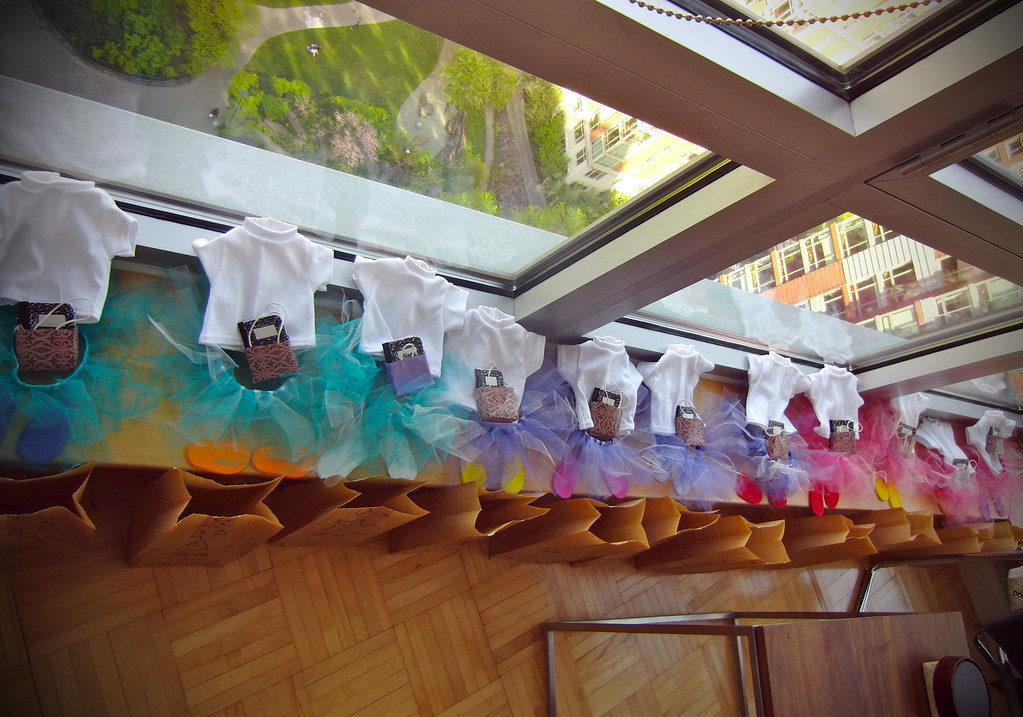
Our daughter, Q, had her 7th birthday last Sunday. My lovely wife has, as usual, been working for weeks on parts for Q’s party, the theme of which this year is designing for dolls. The whole idea can be described as Extremely Girly, but all of us like to make and to encourage the making of things, even if that means inviting 8 girls over to make their 18"* dolls pretty.
And how they did prettify those dolls. We’ve found a guest list of around 10 or so manageable in our apartment, so we set and hit that target this year, too. My wife knows the fabric stores just south of Canal Street well, and she came back from one of them with a roll of elastic that she cut and sewed into rings. To those she tied strips of colored tulle (also bought in bulk at the fabric store and disassembled) to make great doll tutus in a variety of colors. She also ordered doll-sized plain-white t-shirts for each girl to decorate during the party with fabric markers and an iron-on flower positioned as each girl liked. My wife had their feet covered as well. Q asked each girl ahead of time about her footwear-color preference and made a list with the results, which we then used to cut craft-foam soles for sandals. During the party, the girls chose ribbon to loop over their doll’s feet, which my wife then hot-glued together with the foam. The girls could then affix sequins and other shiny ornaments to the ribbon to complete the bespoke shoes. Even the parting goody bags were for the dolls — little wrapping-paper shopping bags containing a miniature composition notebook and a toothpick pencil, all handmade and clever. Overall, the craftwork was basically insane in its tediousness, but the results (pictured above and below) truly amazed.
 |
| Note: To grasp scale, the pencils are made from toothpicks |
At this age, the parties tend to be drop-off, and we kept the girls busy. The Boy, who expertly helped make the tiny pencils, fled the house early to a series of friends’ places, and he made me swear that No Girls Be Allowed In His Room.** Q more or less floated to the door when the bell rang, and the just-arrived guest then accompanied her to the door at the next bell, building the greeting with each newcomer. Once they had all come, dolls in the crooks of their elbows or fastened into little carriers with cutouts for their faces, the girls set to work decorating their shirts. My wife set up a hot-glue station on the far side of the room, which the girls took turns visiting while they waited for me to iron flowers onto their doll shirts. I kept the snacks and drinks fresh; Q did the same with the overall atmosphere. After the girls had made shirts and sandals and dressed their dolls in the new tutus, we had them all sit and eat. Originally we thought we’d order pizza (like nearly every kid party ever), but we offered the group a choice between that and dumplings, and it was no contest. And, man, can 9 seven-year-old girls put away the dumplings.
Then it was cake time. My wife now has a well-earned reputation, inside our house and out, for great birthday cakes. This year she made a two-layer lemon number with sky-blue frosting and purple-sugar accents. The only decoration (besides Q’s name and the requisite wish piped at the bottom) was a tiny feathered gown and handbag hung on a miniature clothesline. I know my wife thought it fell short of her best efforts, but I thought it was, like her, elegant and beautiful.
We asked the moms to come back a little before the party’s end for a doll fashion show.*** Once the audience was in place, we lined the girls up in our apartment’s hallway and put on some music. They took turns looping through the living room, showing off the clothes they just made as the adults clapped. The girls themselves wore big smiles of fun and a little embarrassment, but most of them wanted to do it again. Q had a great time, and we hope that everyone else did, too.
A. A. Milne’s poem “The End” from his collection Now We Are Six goes:
When I was One,
I had just begun.
When I was Two,
I was nearly new.
When I was Three,
I was hardly me.
When I was Four,
I was not much more.
When I was Five,
I was just alive.
But now I am six, I’m as clever as clever.
So I think I'll be six now for ever and ever.
This poem is one of Q’s favorites, and mine too, but for different reasons. She likes the short, smart rhymes and the little story it tells that we can easily add on to as we walk to school or wonder about the bus.**** I like that, too, but also how Milne captures the way kids sometimes treat time as just another choice to be made while he himself participates in that choice. Milne calls the poem “The End” and hands it to his reader on the way out of the book, and in doing so gives the last line a type of truth, though Christopher Robin eventually left the nursery and the Hundred-Acre Wood and, ultimately, this earth. In a sense, then, Milne also wants his son to be six now for ever and ever. I understand the impulse.
That evening, after Q and The Boy had come down enough from the day to give in to the night, the house gets still. It’s been raining solid and hard all day, the storm knocking on all the windows at once, wanting in. Quiet comes on, at first before it’s noticed, like a brush of breeze that stands out once the air goes calm. These are times when it’s hard to believe that quiet is like cold — an absence of something rather than a thing in itself. Outside, the Hudson River slows and smooths, then stops altogether, the ferries frozen at the tip of their wakes like brushstrokes. See a dog caught mid-bark just off the park, its owner in a swipe at his phone; the trees bent by the wind stay bent. I can take this world and turn it, can find Q in every corner. At her desk in her room in a book, then making lists with a pencil that needs sharpening. Out front with her hands deep in the sand, looking to see if I’m looking at her. On line for Italian ice from the man on Chambers Street who knows her well now, both of them wondering which flavor she wants this time. Hanging upside down on a playground bar and showing someone how it’s done. Always everywhere there’s that face of hers, the one where she half-closes her eyes and half-smiles, meaning she’s seen through a joke or an attempt at a tease.
Q, asleep, exhaled. The Hudson wrinkled itself back up, and the ferries aimed for their slips. I thought I heard the dog finish its bark, but it was hard to tell over the rain.
Happy birthday, Q. Now you are seven, still as clever as clever. We will love you forever and ever.
_________________________
*I’m deliberately being general here. American Girl used to own the 18"-doll category pretty much outright — every girl but Q brought one of these to the party — but some compelling newcomers have recently moved in on AG’s territory. Q (now) has two Journey Girls dolls, which do look slightly different than American Girls, only noticeably so when the two get put side-by-side and a person really looks. Other differences exist too, but they trigger thorny questions about class and feelings of inadequacy that can extend into adulthood, so I’ll stop right about here.↩
****We’ve decided that it should now go: “When I was six / I learned some tricks. / But now that I’m seven, I’m as clever as clever…” Now you try.↩
Thursday, March 29, 2012
Science!

The Boy’s project came out of a short video I stumbled across in the usual Internet way of a guy out on his deck dropping magnets down a copper pipe. Like any good magician, he shows his audience the two pieces separately, and then performs the trick, exploding all expectations in the process. The magnet doesn’t stick to the pipe but instead tumbles softly down into his hand. When it came time for The Boy to settle on his topic, he remembered the video right away and wanted to go looking for the explanation.
The short clip gave us a couple of leads — neodymium, eddy currents — so that’s where we started. The magnets were easy to get off the Internet, arriving in a couple of days in a clear plastic tube wrapped in warnings. The pipe was a lot less easy to come by, oddly enough. Lots of places in town would sell us a contractor’s standard ten-foot length, but we only wanted a foot or so. After much walking and asking around, we finally found a hardware supply in Chinatown with a manager who happily opened one of his own pipe-cutter packages to accommodate us.
Once outfitted, we went for replication. Would our own neodymium magnet float down our own copper tube? Check. Even having seen the video, The Boy and I found the result hypnotic, the pleasant clink of metal on metal, the lazy drift of the stack of magnets down into his waiting palm.
Explanations pair with questions, and The Boy compiled a list of them to answer in his presentation, including:
- Why doesn’t the magnet stick to the copper tube?
- Why does the magnet float down the tube?
- Does the tube have to be made of copper for the magnet to float?
- What is an eddy current?
We guided him a bit, but he did most of the heavy lifting research wise. Finding information for this kind of thing used to be difficult, but now the difficulty lies in sorting and understanding information. We googled magnet- and eddy-current-related phrases and turned up all sorts of videos and cryptic equations, along with pages of physics and industrial applications, and a few fairly simple explanations. The Boy took notes. We also actually went to our local library (nostalgia!) for age-appropriate books on magnets and magnet experiments, which proved to be a mother lode of Fun Facts.
You may very well be curious about answers to The Boy’s great questions, and though I don’t have my son’s showmanship, I’m happy to oblige with grade-appropriate answers. First off, copper is not ferritic, which means magnets aren’t attracted to it. But copper is an outstanding conductor, and that’s important here. A magnetic field moving through a conductor causes electric currents called eddy currents. All electric currents have their own magnetic fields. So gravity pulling a strong magnet (in this case, four 1” x 1/8” neodymium stacked) down the conductor triggers eddy currents, which have their own magnetic fields that repel that falling magnet, just as the same poles of any two magnets repel. The eddy currents and their magnetic fields prove fairly weak (again, in this case), which means the magnet’s progress is only impeded and not arrested altogether.
Cool, right?
The Boy insisted (before we could) on writing the text of the poster himself, first translating his notes into an explanation on paper, and then typing everything up to be printed. We spent some serious time in font selection. My lovely wife helped him with the big center diagram, though it was his idea to have a foil-wrapped magnet popup in the center. He was proud of his work, and he had good right to be.

The day of the Expo, he carried his equipment and excitement to the gym himself. It opened to parents shortly after the morning bell rang, and my lovely wife and I flooded in with all the others to check everything out. We went by The Boy first, of course, and he was all set up and ready to perplex passersby with his “Magnet Mystery” (his poster’s title). He performed his demonstration for us just as he’d practiced — first asking what we thought would happen when he dropped the magnet down the copper tube, then asking for predictions about the same magnet going down a cardboard tube, then explaining all the forces at work that confounded those predictions. Q soon came by with a pack of her classmates (all grades visited throughout the day) to listen to her brother, and he enjoyed the audience. He was truly great.**
As were so many of the kids. We know lots of families now, and we took our time hearing The Boy’s friends tell us about mass and gravity, geysers, rainbows, penguins, great white sharks, milk carton turbines, and on and on. The girl set up right next to The Boy talked through a truly unsettling experiment on the effectiveness of soap v hand sanitizer, one that involved a UV flashlight that revealed the dirt on your hands right then and there. For my part, I managed to discomfit a kid with a nice display on color vision by asking her since different creatures have different color experience what she thought the real colors were. “I dunno,” she said, looking up the aisle and anywhere else but at me. Sometimes I wonder why I don’t end up eating all my meals alone.
Aristotle writes that all persons by nature desire to know.*** It can be an oppressive statement if you think about it — the need to explain nagging and persistent, like an itch. And there’s so much to be known. Spring bloomed suddenly, some afternoons have been pushing 70º already, and the early warmth and wet air have produced glorious morning fog. Fog occurs when the ambient air reaches saturation, forming water droplets that reflect light, limiting visibility to at least 5/8 mile. Copper: Chemical element name Cu; Atomic Number: 29; melting point: 1356.15K. Celestial bodies lie in space like balls on a rubber sheet, curving space and time around them. The body a machine, describable and flawed. A second is equal to the duration of 9,192,631,770 periods of the radiation corresponding to the transition between the two hyperfine levels of the ground state of the caesium 133 atom. Consciousness is an instance of consciousness of. F = ma, except when it doesn’t. The Boy is an isotope of my wife and I; the recipe for his making written in a billion proteins. Q hums sweetly while brushing her teeth (though she’ll deny it) — this a fact like any other.
Anyhow, thanks to The Boy, at least one mystery is explained enough.
_________________________
*Nearly every third grader’s poster included Fun Facts, where “Fun” means something like Related But Random and Interesting. The science teacher probably suggested including them as a way to fill white space, which, given that this is likely the first public opportunity these kids had to present a poster, must have seemed positively Antarctic to most of them.
**Dare I say he was magnetic? I do dare say so, at least in a footnote.
***The opening line of his Metaphysics, usually translated as all men desire to know, but he’s dead enough to be forgiven this oversight. Also, perhaps no one better encapsulated this desire than Aristotle himself.
Friday, March 16, 2012
Body shop
I start my 22nd session of physical therapy, as I’ve started the 21 others, by paying upfront. I pretty much have myself and pickup basketball to blame for my broken wrist and the surgery to right it, but many people coming here to come back from their injuries are in the middle of legally faulting someone else, and who knows when those suits will result in costs being covered, so they insist.
After I put the receipt with the others, I hang up my coat in the odd little closet* and go back to whichever of their two rooms has an open seat. This office specializes in hands, arms, and shoulders, and it’s nearly full, as always. Most people spend many weeks in physical therapy, and I recognize almost everyone. The Belgian high-school girl who hurt her finger playing varsity volleyball pokes neon-colored putty to work her grip. The two female cops sit together as usual, cracking each other up with cop-speak jokes and comparing workman’s comp attorneys. The young guy with two phones comes later, talking to a series of people while a therapist sends electricity through a muscle in his forearm. I haven’t seen the woman with the plastic-surgeon dad in a while, probably since she can get cortisone shots at will. Once, after I had become a regular, I actually found myself saying to a stranger next to me whose shoulder was being unbandaged: “What are you in for?”
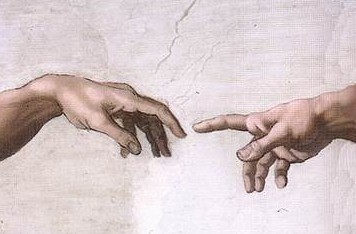
I find a place in the room where each seat has a wooden TV-dinner tray next to it, rickety as the limbs leaning on it, and with the obligatory lithograph of Escher’s hands drawing each other to life, which almost makes literal sense given its context. The other room has old elementary-school desks for tables and a framed closeup from Michelangelo’s Sistene Chapel ceiling, the really famous part where God reaches out to Adam’s limp (injured?) hand. The entire place has an oppressive level of metaphor density.** The woman who works me over twice a week asks how my wrist feels, and I say “fine” because, like all questions of this sort, its answer is pure ornament. She’s good at juggling patients, has to be, and she lays a big blue bag of heat on my hand to loosen it up and returns to someone else in the other room.
Sessions are like getting your hair cut, only your hair is broken and it hurts. My therapist and I have been through so much small talk in two months that I have a fuller picture of her than most of my coworkers and neighbors. I know that she plays mahjong with her friends twice a month and that she picked up the game pretty quickly from her grandmother. I know that her husband is finishing up his MBA and has an enviable ease with foreign languages. (I know that his grandmother is a surly Holocaust survivor.) They’re childless but thinking sometime maybe eventually. She’s left handed and is forever after whoever borrowed her special scissors. I know where she and her husband are each from originally and what they’ve done more or less every weekend for the last two-and-a-half months — something I no longer know about myself.
After she returns and removes the heat, I do some wrist curls with a 5 lb. weight, then squeeze an old gripper thing 30 times. Once I’ve limbered*** up a bit, my therapist bends my wrist. Hard. We do what she gamely calls a “strong stretch” that usually involves me looking away and down from the hurt while she applies her full body weight to my hand and aims for 90º flexion. I try the Zen thing of detaching myself from the material experience. I cycle through pictures in my head. My arm as cold dough that grows more pliable as its folded and rolled. A car door iced shut overnight finally coming free. An iron bar glowing orange on an anvil, throwing sparks at each hit, but taking shape. The Tin Man choked with rust, already with a heart but needing oil and an adventure to discover it.
The idea of physical or occupational therapy, the purpose, arises out of the fact that adults cannot be trusted to properly harm themselves after injury. Expertise is involved, too, of course — bodies can break in so many ways.**** Each of the three times the cast came off my son’s arm, he was unleashed back onto the baseball field and into the schoolyard and the swimming pool, without need for therapy. His body is a riot of growth, which helps with recovery from just about anything, and he (like most kids) can easily forget hurt. Adults, though, generally have vivid memories of pain and tend to convert it and anticipation of it into suffering. We quickly restrict or retire hurt limbs, which in turn leads our bodies to slowly give up on them. After I hurt my wrist back in May, I wrapped and iced and defended it for several weeks to give it time to heal itself, but time instead eroded my range of motion. And then the surgery and the pins and surgical screw and the nine-week cast all conspired to fix my hand straight. Now it has to be bent further than I want it to if I want to come back.
The Zen thing doesn’t work. My wrist pops and smarts like hell but won’t stay past my best angle reached a few weeks ago. My PT reminds me, again, of how I came in, with flexion and extension of basically 0º, to make me feel better about where I can get to now, which is 50º and 60º respectively. It occurs to me that the old saying really should go, “Time fixes all wounds,” with ‘fix’ smuggling in all its senses.
All the effort going on in rooms makes them stuffy, and my PT cracks the window near my seat. The days have gotten glorious, and I’m glad to welcome in the loud warm air of 57th Street. I think of Q and her classmates running in the schoolyard, waiting in the 60° morning for the bell, how they shed their coats and become their bodies.
We’re all done, she says. See you next week.
_________________________
*I’m fascinated by this closet, possibly unhealthily so. It seems to contain roughly twice the space of the waiting room it’s off of, and its bar is stocked with weirdly thick hangers, like bunch of taupe hotdogs bent into triangles.
**Example: The Michelangelo print is even from before the restoration, meaning it has visible cracks running across the arms of both God and Adam.
***One thing I learned while writing this: The word ‘limber’ does not, lexicographers apparently think, share the same origin as the word ‘limb’. According to The Oxford English Dictionary, ‘limb’ can be traced back to Old English’s lim, which means strong. The OED says that ‘limber’ probably entered the language much later (around the 16th or 17th century) and may have the word ‘limp’ as an ancestor. I know, right?
****The Wikipedia page on “physical therapy” makes for good reading. Assuming what’s there is mainly true, PTs in the U.S. were first called “reconstructive aides.” It says that the first American PT school was at Walter Reed Army Hospital in response to injuries incurred during World War I, and the first professional organization, founded in 1921, was called the “American Women’s Physical Therapy Association.” Though this approach to convalescence can be traced back to Hippocrates, modern physical therapy cut its teeth on war and polio, and was almost exclusively performed by women.
Friday, March 02, 2012
Data dumped on

I like to think the best of people. I try to start with the assumption that everyone believes, honestly, in what she considers good reasons for something, even if that something and those reasons turn out to be misguided about something extremely important.
The New York City Department of Education recently released performance rankings for 18,000 New York City public school teachers. In the New York Times’s summary: “The reports, which name teachers as well as their schools, rank teachers based on their students’ gains on the state’s math and English exams over five years and up until the 2009-10 school year.” In the report, each teacher (or set of teachers) receives a percentile ranking indicating whether the teacher is Low (0-5%), Below Average (6-25%), Average (25-75%), Above Average (75-95%), and High (95-100%).
Everyone pretty much agrees by now (or should at any rate) that performance on standardized tests reveals precious little about individual students and even less about their teachers. Here’s a simple example: Scores on a single test may be indicative of academic level (and, more tenuously, of teacher competence), but such scores may better represent inadequate breakfasts, wrong sides of beds gotten up on, bad pencil luck, and on and on and on. Not to mention the deep and abiding structural walls/ramps of economic strata and cultural pressures of family and community. Average scores may also vary widely across classes because, for very real example, one teacher’s students arrived day one better prepared than the other and therefore test as such. A teacher with the lower average score could in fact be “adding more value”* than his colleagues — his students could have scored far better due to his instruction than they would have without it, even if they ultimately scored lower than fourth graders a door or county over. In sum, standardized test scores could easily be the result of a galaxy of external factors that have nothing whatsoever to do with teacher potential and performance, which means they make an exceedingly poor metric for evaluating teachers in any real way.
At this point one could just jettison the whole project of trying to judge teachers (and perhaps even students) via standardized test scores, or one could try to evaluate the scores in a more sophisticated way. The NYC DOE and other places have gone for the latter, calculating the very personal percentages dumped last week via what’s called a “Value Added Model” (VAM). VAMs more generally are mathematical models designed to factor in (and therefore factor out) the swarm of influences on students to isolate the contribution of the teacher to student performance, thereby giving the “value added” by the instructor. A very (very) simple version of this is having students take an exam early on in the year to serve as benchmarks, testing them again later in the year, and then comparing scores to gauge improvement. VAMs try to account for all sorts of external factors so that the internal cause of student performance (viz., teaching) can be revealed. (For a great and extremely accessible primer on VAMs, see a paper by John Ewing in the May 2011 Notices of the American Mathematics Society.)
Not a bad idea if it works — this is me still trying to think the best of everybody — but it’s not at all clear that it does. As some have pointed out, the data collected is shot through with errors, from mis-attributed test scores to altogether absent data to sample sizes to small for the statistics they support (classes of 10 students, etc.). These kinds of error can perhaps be avoided with tighter reporting, assuming public schools have the funds and personnel to dedicate to that sort of thing.** The more troubling inaccuracy, though, is with the VAM itself. As you can tell from the examples just two paragraphs back, the factors contributing to student preparation and success prove exceedingly complex and quickly vexatious. The accuracy of VAMs hinge on our ability to sort the causally relevant from the irrelevant and the external causes of performance from internal ones. But how do we even go about knowing when we’ve sufficiently accounted for external factors and properly weighed them? How would we feel confident that the model is comprehensive enough to produce meaningful results about classroom performance that could be leaned heavily upon in tenure and promotion decisions? Again, not at all clear, at least not at this point. VAMs therefore turn out to be extra pernicious because they give the powerful but false impression that we’re talking directly and purely and with precision about how an individual teacher contributed to overall student learning. And this type of report will be used by the State of New York to formally evaluate teachers, which is, simply put, a travesty.
The NYC DOE apparently recognizes and admits*** the report's limitations by listing individual teacher scores with margins of error of 35 percentage points for math and 53 for English. Doing so, though, reveals the rankings as farce as well as travesty. Even a 35-point swing means a teacher rated dead average by the DOE’s model (a 50) could for all anyone knows be an Above Average 85 or a fireable Below Average 15. The swing is even more dramatic and therefore more risible for English scores. As commenters on various New York Times pieces quickly pointed out, metrics with this kind of error slack would be laughed right out of most anywhere else. Consider: “In 2012 Jeremy Lin had a field-goal percentage between 27 and 80%”; “Last year this fund had a rate of return of 9%, give or take 35%;” and, more pointedly, “Chancellor Dennis M. Walcott performed his duties somewhere around the Below Average or Average or Above average level,” etc., etc.
Look, I’m not one of those Teaching Is An Art Not A Science people. I’ve been working in higher education for around 15 years as an instructor and administrator. Colleges and universities have likewise been swept up in assessment mania, and I see and hear lots of resistance to attempts at evaluating what students gain by attending a particular institution. Push-back in many cases is warranted. But principled resistance — resistance to the idea of evaluating what you do in your classrooms as a teacher and/or a administrator — sells people and disciplines and institutions extremely short. A teacher of any sort should be able to say pretty explicitly what she wants students to learn skill- and content-wise, how she plans to get her students there, and how she will figure out whether they’ve made it.**** Assessing teaching and learning isn’t easy, of course, on any level, but it’s worth doing and doing well. The problem is, “well” most likely means either more individualized and extensive personal evaluations of students and their teachers (hyperlocal) or, if you like your tests standardized, more aggregate measurements of entire districts or systems looked at as aggregates à la Finland. Either way, “well” means not viewing the results as opportunities for punishment and reward. The NYC teacher data dumped last week doesn’t get close to assessing well: It’s too flawed, too personalized, too high-stakes, too susceptible to misunderstanding and misuse.
I could go on. I could speculate about why the NYC DOE and the state would distribute and base decisions this report, but that exercise always pushes me downhill into despair to the point where I begin to wonder exactly when we stopped being serious about important things. I’ll stare into these abysses on my own time.
I do, though, want to spend a little time here not understanding why the New York Times acted as it did. As the Times itself will tell you, the paper sued to obtain the teacher data and won, despite the protestations of the United Federation of Teachers. No problem there; the data being used to hire, fire, and promote public school teachers should be looked at by people other than those who hire and fire. However, the real story turned out to be the extent to which this data is flawed and misused. But the Times published the data itself anyway in an easily searchable form, thereby making it nearly effortless to gawk at the results that various of its writers wring hands over.
If the data is so bad and misleading, why publish it? Here’s the Times’s answer:
Why did SchoolBook decide to publish these evaluations?Sorry, but I don’t buy it. If Times writers and editors really did “share some critics' concerns” to the degree indicated by their treatment of this whole issue, they wouldn't have made it so simple to see the 36 given to your fifth-grader's teacher. The data could have been anonymized and/or excerpted for publication. As is, the concerns and caveats preclude any proper context for these results: I have no way of knowing whether the competence of my kids' teachers falls on the thick black error bar let alone where. Putting up a mechanism for teachers and the general public to respond doesn't help either; those kinds of things don't receive the same level of attention as the numbers themselves. In my more cynical moments, I begin to think that the actual context for the story involves the Times's pageview counters.
The New York Times and WNYC, who jointly publish SchoolBook, believe that the public has the right to know how the Department of Education is evaluating our teachers. Since the value-added assessments were being used for tenure and other high-stakes decisions, we sued for access to the reports. While we share some critics’ concerns about the high margins of error and other flaws in the system, we believe it is our responsibility to provide the information, along with appropriate caveats and context, for readers to evaluate.
Teaching is good, hard work. I remain puzzled why we seem so determined to make being a teacher so difficult.
_________________________
*Pardon the cringe-inducing quotes. **A yellow-bus sized assumption there, of course.
***I did have “pretends to recognize” and “sort of admits,” but I'm still trying to exude a generosity of spirit here.
****In many ways the problem for higher ed is more acute because college-level teaching involves somewhere around zero hours of required faculty development or teacher training, even though it's almost a theorem that research performance is inversely proportional to teaching ability. Lord knows I struggled early on in my classrooms, and I still find myself confounded sometimes. K-12 teachers at least have to go through education courses and student teach, say what you will about their training.
Subscribe to:
Posts (Atom)